
• Skip to main content
  • Skip to navigation
  • Accessibility
  • Contact Us
Government of Western Australia Crest
Government of Western Australia
Government of Western Australia Crest

Additional Menu

  • Accessibility
  • Contact us
Go to WA Government search
  • About us
    • Contact us
      • Compliments, complaints and suggestions
      • Misconduct
      • Thanks to our staff
    • Provide feedback
    • Health Service Board
    • Executive
    • Vision and values
    • Past adoption practices
    • Strategic Planning
    • Annual Reports
    • Freedom of Information
    • Statewide services
  • Hospitals and Services
    • Hospitals
      • Sir Charles Gairdner Hospital
      • Osborne Park Hospital
      • King Edward Memorial Hospital
      • Graylands Hospital
      • Joondalup Health Campus
    • Mental Health Services
      • Community Adult Mental Health
      • Inpatient Adult Mental Health
      • Mental Health Specialties
      • State Forensic Mental Health Services
      • Community Advisory Council
    • Public Health
      • DonateLife
      • Health Promotion
      • Humanitarian Entrant Health Service
      • Boorloo Public Health Unit
      • WA Acquired Brain Injury Rehabilitation Service
      • WA Tuberculosis Control Program
    • Older Adult Health Hub
    • Dental Health Services
    • Services
      • Aboriginal Health
      • Cancer Network WA
      • Elective surgery
      • Emergency Departments
      • Maternity Services
      • Residential Care Line
      • Interpreters and Language Services
      • Video Consultation
    • Voluntary Assisted Dying
  • Patient Care
    • Safety and Quality
      • Patient safety
      • Quality of care
      • Maintaining high standards of healthcare
    • Aishwarya’s CARE Call
    • Manage My Care
    • Patient rights and responsibilities
    • Partnering with Consumers
      • Become a consumer representative
      • Community Advisory Councils
      • NMHS statement on family and domestic violence
      • Partnership Model
      • Volunteering
    • Carers
    • Choose Wisely
    • Disability Access and Inclusion
    • Patient resources
  • Health Professionals
    • Referring Patients
    • Older Adult Hub
    • Boorloo Public Health Unit
      • Syphilis outbreak
      • Notifying disease and outbreaks
      • Immunisation
      • Perth Public Health Officer Training Program
      • Rabies post-exposure prophylaxis (PEP)
      • Reports, publications and resources
      • Forms
    • GP Liaison
    • Library and Information Service
    • Staff Exposures and Absences Form
    • CADD Standards
  • Research
    • About our research
    • Research ethics and governance
    • NMHS Research Strategy
    • Research news
    • Why undertake research
    • Current research
    • Research partners
  • Work with us
    • Aboriginal employment and recruitment
    • Employee benefits
    • About us
    • Staff stories
    • International and interstate recruitment
    • Nursing
    • Midwifery
    • Allied Health
    • Forensic Mental Health
    • Mental Health
      • Mental Health Transition to Practice Program
    • Medical
      • Interns
      • Overseas trained doctors
    • Dental
    • Graduates
      • Mental Health Transition to Practice Program
      • GradConnect
    • How to find NMHS jobs
    • Career opportunities
    • Pathways to working with us
    • Diversity and inclusion
    • Volunteering
  • Latest News
  1. Home
  2. News
  3. 2026
  4. 10
  5. 23
  6. Helping critically ill patients get the nutrition they need

Helping critically ill patients get the nutrition they need
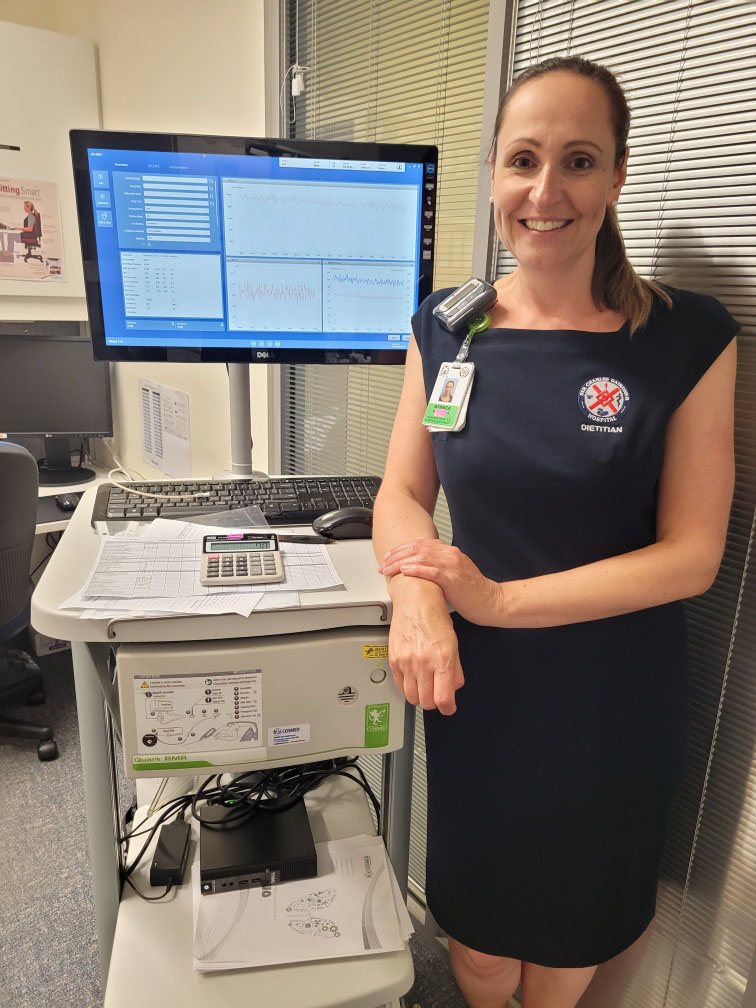
Helping critically ill patients get the nutrition they need

Bianca Mammana SCGOPHCG Dietitian Bianca Mammana
23/10/2026

Sir Charles Gairdner Osborne Park Health Care Group Senior Critical Care Dietitian Bianca Mammana has recently undertaken a research project to help critically unwell patients in the Intensive Care Unit (ICU) get the nutrition they need.

The project has led the implementation of indirect calorimetry devices being used in the ICU to tailor nutrition to individual needs, minimise energy deficits or excesses, and provide safer, more precise, best-practice nutritional care.

Bianca has spent much of her career caring for some of the sickest patients in the hospital and looking for ways to optimise their nutrition.

She said that despite the highly precise and personalised care provided in intensive care, nutrition was often based on estimates rather than what a patient actually needed.

"Critically ill patients have rapidly changing and highly individualised energy requirements, and indirect calorimetry allows us to measure those needs and adjust nutrition accordingly," she said.

The research involved comparing patient’s measured energy requirements with commonly used predictive equations and explored how their energy needs related to infection and illness severity.

The results showed substantial differences between estimated and measured requirements, highlighting the limitations of relying on predictive equations alone and supporting the use of indirect calorimetry to better guide nutritional care.

Bianca's research led to the implementation of this technology in the ICU, and it is now routinely used in suitable critically ill patients as part of the standard of care.

"One of the most rewarding outcomes has been seeing our research translate directly into everyday patient care at SCGH ICU," said Bianca.

"The biggest benefit is that we can now personalise nutrition care based on what a critically ill patient’s body actually needs, rather than relying solely on an estimate.

"For me, that is the real value of translating research into practice – using evidence and technology to make nutrition care more precise, responsive and personalised for patients when they are at their most vulnerable."

Bianca's research was funded by both the Charlies Foundation for Research and the NMHS Building Allied Health Research Capacity Grant.

The funding has helped turn Bianca's findings into broader impact through presentations at state and national conferences and contributions to clinical guidelines.

Previous Next
Last Updated: 23/10/2026
  • Facebook
  • Instagram
  • LinkedIn
  • YouTube

Footer menu

  • wa.gov.au
  • Copyright
  • Disclaimer
  • Privacy
  • Sitemap
  • Contact Us

Brought to you by the Department of Health, Western Australia

© Government of Western Australia 2018 to